Trailer, Flushing Unit or Standard: Picking Wedding Restrooms
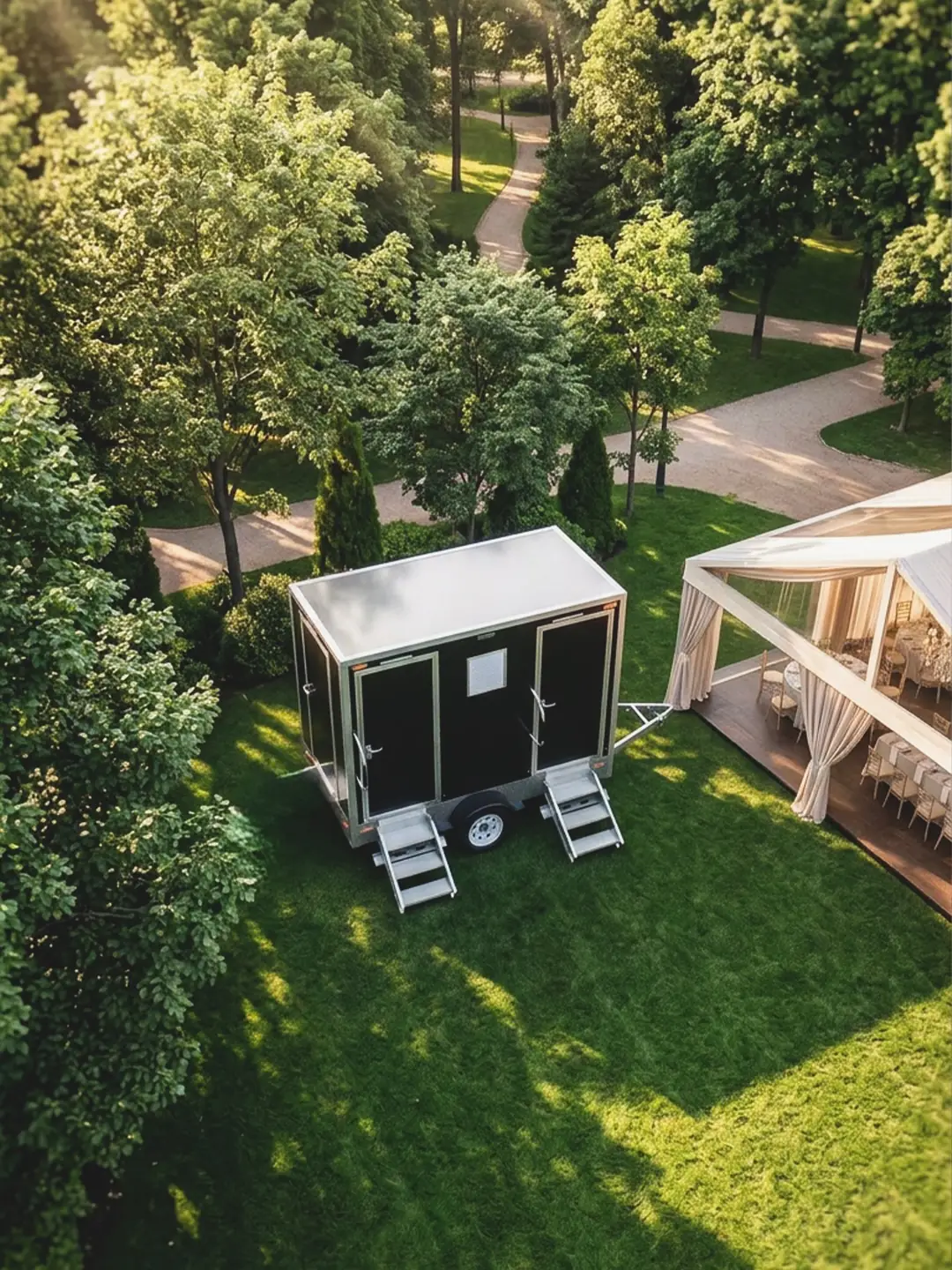
Restroom trailer vs porta potty for a Texas wedding? The choice comes down to guest count, budget, hookups and ground. This guide lays out the real trade-offs so you can choose once and move on to the fun parts.
What are the 3 restroom choices for a Texas wedding?
A Texas wedding usually picks from 3 restroom types. A standard porta potty runs $225–$295, and a flushing unit with a sink runs $345–$475. A 2-stall restroom trailer runs $1,200–$2,500 per weekend. The trailer needs power and level ground. The other two need no hookups.
| Feature | Standard unit | Flushing unit with sink | 2-stall restroom trailer |
|---|---|---|---|
| Price | $225–$295 per event | $345–$475 per event | $1,200–$2,500 per weekend |
| Inside | Seat, urinal, sanitizer | Flush toilet, foot-pump sink | Flush toilets, vanity sinks, mirrors, lights |
| Power | None | None | Standard outdoor outlet |
| Water | None | Own fresh-water tank | Often a garden hose connection |
| Ground | Flat and firm | Flat and firm | Level, with room for the truck and trailer |
| Best fit | Casual, budget-first | Most backyard weddings | Larger or formal receptions |
A middle step exists too. A VIP luxury restroom cabin runs $450–$650 and gives a single, roomier space without a trailer hitch.
How many restrooms does a wedding of 100 to 200 guests need?
A 100-guest wedding over 5 hours with a bar needs about 3 standard or flushing units. A 150-guest reception over 6 hours with a bar needs about 6. These counts use 1 unit per 50 guests per 4 hours, plus 20% more capacity when alcohol is served.
| Guests and hours | No bar | With a bar |
|---|---|---|
| 75 guests, 5 hours | 2 units | 3 units |
| 100 guests, 5 hours | 3 units | 3 units |
| 150 guests, 6 hours | 5 units | 6 units |
| 200 guests, 6 hours | 6 units | 8 units |
For a trailer, we match stall count to your guests and hours on the call.
If any guest uses a wheelchair or walker, add a wheelchair-accessible unit at $295–$425. Section 213.2 of the 2010 ADA Standards asks public events for at least 5% accessible units per cluster. Read the Access Board text of section 213.
What does a restroom trailer need at the venue?
A restroom trailer needs 3 things at the venue. It needs level ground, a clear path for the truck and trailer, and a standard outdoor power outlet. Many trailers also use a garden hose for fresh water. Without power at the spot, a flushing unit with its own tank is the simpler choice.
- A trailer will not fit through a backyard gate. Plan for a driveway, side lot or field edge.
- Soft clay after rain can stop a trailer. A gravel or paved pad is safer.
- An extension cord across a dance floor is a trip hazard. Find an outlet close to the spot.
- The trailer has steps. Older guests may prefer a ground-level unit nearby.
Is a flushing unit worth it over a standard porta potty?
A flushing unit costs $345–$475 per event, compared with $225–$295 for a standard unit. That gap is about $120–$180 per unit. You get a flush toilet and a foot-pump sink inside, with no hookups. Guests in suits and dresses wash up without walking to a separate station.
People often ask whether a standard unit plus a station costs less. A hand wash station runs $95–$175, so the pair totals $320–$470. That lands close to one flushing unit, but takes up more space.
A flushing unit carries its own fresh-water supply. For big guest counts, add units rather than counting on a single one all night. See specs on our flushing porta potty page.
When does a restroom trailer make sense for a wedding?
A restroom trailer makes sense for about 100 or more guests at a venue with power. Plan on $1,200–$2,500 for 2 stalls. Larger 3-stall-plus trailers run $1,800–$3,500. Guests get lights, mirrors and real sinks, which suits formal dress and long receptions.
Fall is busy for Texas weddings, so book a trailer as early as you can. Weekend trailers follow the same Friday drop and Monday pickup as other weekend rentals.
At a Mesquite home, a trailer usually sits in the driveway or a side lot. Check HOA rules first. Street placement may need city approval from Building Inspection at 972-216-6212.
See photos and sizes on our restroom trailer rental page.
What should couples settle before booking wedding restrooms?
Couples should settle 4 facts before booking wedding restrooms. Know the final guest count, reception hours, bar plans and where power sits. With those, a quote takes about 15 minutes. Without them, the count or unit type often changes later, and so does the price.
Restroom trailers have steps. For weddings with older relatives, add one wheelchair-accessible unit next to the trailer.
- Count guests.Use the RSVP total, not the invite list.
- Find power and water.Note the nearest outlet and hose bib to the spot.
- Walk the path.Look for gates, slopes and soft ground between the street and the spot.
- Pick the spot.Keep restrooms out of photos but in sight of the reception, with a lit path.
Our wedding restroom rental page covers packages and placement ideas.
Bottom line: standard units fit tight budgets, and flushing units fit most backyard weddings. Trailers fit large or formal receptions with power. Call (361) 213-6286 with your date and guest count for a side-by-side quote.
Planning something in or near Mesquite?
Call (361) 213-6286 for an itemized quote. Same-day delivery when you call by noon, Mon–Sat.
Questions readers ask
Can a restroom trailer sit on grass?
Yes, if the grass is level and firm. After heavy rain, a gravel or paved spot is safer for the truck and trailer.
Can we mix a trailer with standard units?
Yes. Many couples put a trailer near the reception and a standard unit near parking or the band area.
Will the restrooms be there for the rehearsal dinner?
For a weekend wedding, units arrive Friday and leave Monday. A Friday rehearsal on the same property can use them.
How far from the dance floor should restrooms go?
Far enough to stay out of photos and noise, close enough that guests can see them. A lit path of 50 to 100 feet works for most yards.